A surgical technologist wants to confirm the size of a screw before a scheduled surgery. On the manufacturer's website, she finds the system's name in a menu of specialties. The sizes are in a forty-page PDF catalog; the codes for each product, in a table at the end of another file. The IFU lives on a subdomain that doesn't link to either one. In the end, she writes to the sales rep, who has everything saved on his computer.
With some variations, that scene appeared across many of the sites included in our August 2026 discovery.
How the discovery was conducted
We opened 65 manufacturer and distributor websites: 15 from Western and Central Europe, 18 from Spain and Portugal, 18 from Mexico and Colombia, and 14 from Argentina, Chile, and Uruguay. Most work in orthopedics and trauma, spine, arthroscopy, dental implants, ophthalmology, or surgical instruments. The discovery was completed on August 19, 2026.
On each site, we looked at where the product lives, what data its page has, how it relates to its documentation, how the catalog is filtered, what the language versions cover, and who can access what. To organize what we saw, we used a 23-variable grid that measures the gap between the complexity of each company's portfolio and the digital structure that supports it. Aesthetics and speed were deliberately left out.
The discovery has its limits. It was based on what is publicly accessible, and some companies may have more complete catalogs behind a login for healthcare professionals or a search tool we didn't explore. Product counts are estimates based on what was visible. Company names are not published.
What we didn't find
We didn't find a single one that brought the product page, specifications, code, and documentation together in one navigable place. When technical information existed, it was scattered: the name in the catalog menu, the sizes in a PDF, the IFU on a separate portal that didn't connect with the catalog.
Nor did we find a filter that made it possible to combine anatomical region, procedure, and product family. At best, there was a fixed menu tree, which leaves out the surgeon whose starting point is a fracture or a surgical approach.
What did show up, again and again
Technical documentation, when it had its own section, was a list of downloads: files in upload order, with no search and no connection to the products they describe. As for electronic IFUs, 6 of the 15 European manufacturers had an identifiable IFU portal, and among those that didn't show one were spine and implant manufacturers.
Medical education was handled better than the catalog. Twelve of the fifteen European manufacturers had some form of academy, courses, or events. A course on a technique had its own page; the system used in that technique often had no product page.
The number of languages said nothing about the structure. We found one manufacturer with seven languages on top of a catalog with no product pages, and another with a presence in several markets and only two languages. In the first case, translation had come before architecture.
Access for healthcare professionals appeared on few sites. Where it existed, it was usually a text notice before entering a section, with no access control behind it. Material for the surgeon, the distributor, and the patient shared the same space.
In Spain, Portugal, and Latin America, something appeared that we didn't see in the European group: distributors whose product section was a list of links to the websites of the brands they represent. Anyone looking for a product on the distributor's site ended up on the foreign manufacturer's, and the inquiry continued there.
Several platforms also couldn't keep up: generic site builders with hundreds of products, online stores for products that aren't sold through a shopping cart.
How sites end up there
None of these sites looks like the result of a bad decision. They were built when the company had fewer products and sold in fewer countries, and then each team published its own material wherever it could: Engineering in the PDF catalog, Quality in the IFU portal, Training on the courses page. The site kept adding parts, and nobody went back to map out how they relate to one another.
Integration can be built
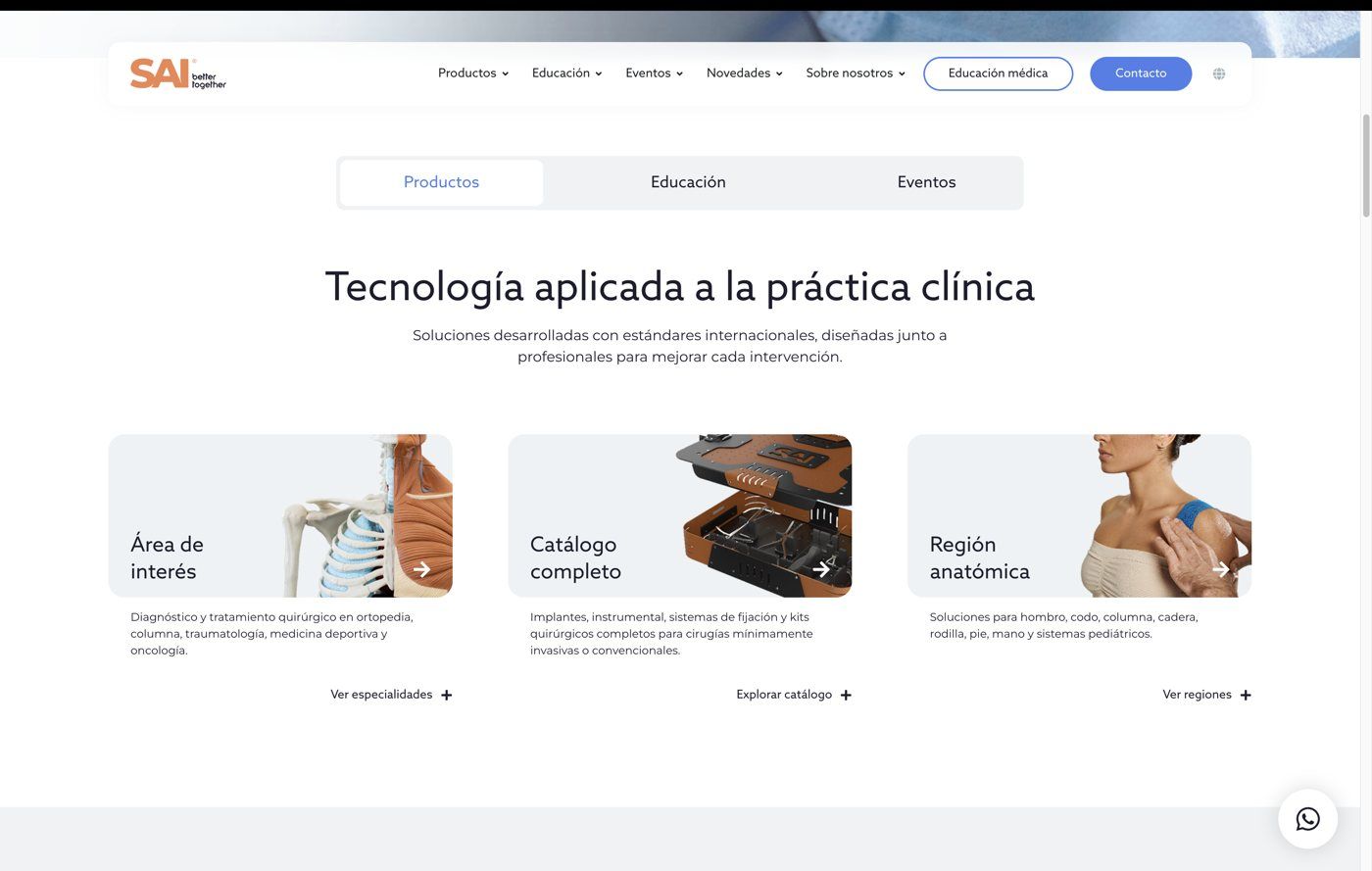
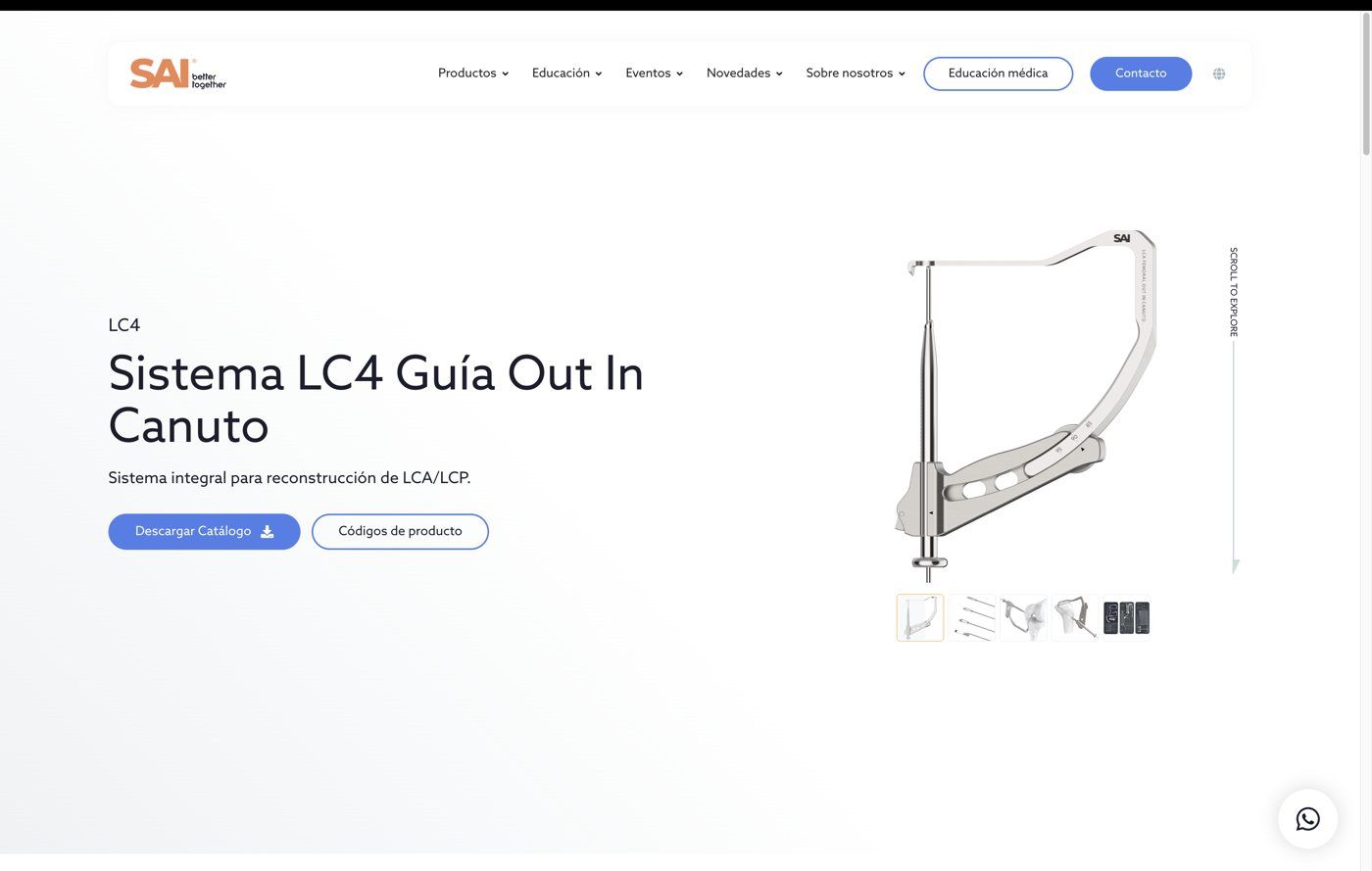
SAI, an Argentine orthopedic manufacturer and distributor, was left out of the 65 because it's our client. On its website, each of its nearly 270 products has a product page that brings together its data, codes, and documents, and the catalog can be browsed through five combinable navigation dimensions: area of interest, anatomical region, product type, procedure, and brand.
The same questions, for the company's own site
The discovery questions also work for looking at a company's own site. Whether each product has a page or lives inside a PDF. Whether that page has the code and the documents that belong to it. Whether the catalog can be filtered or only browsed through a menu. Whether the version in another language covers the catalog or only the corporate pages. Whether someone on the team can add a new product without asking a developer.
The signs that show up internally, once the site no longer keeps pace with the catalog, are in Signs the website has been outgrown.
Services covered in this article