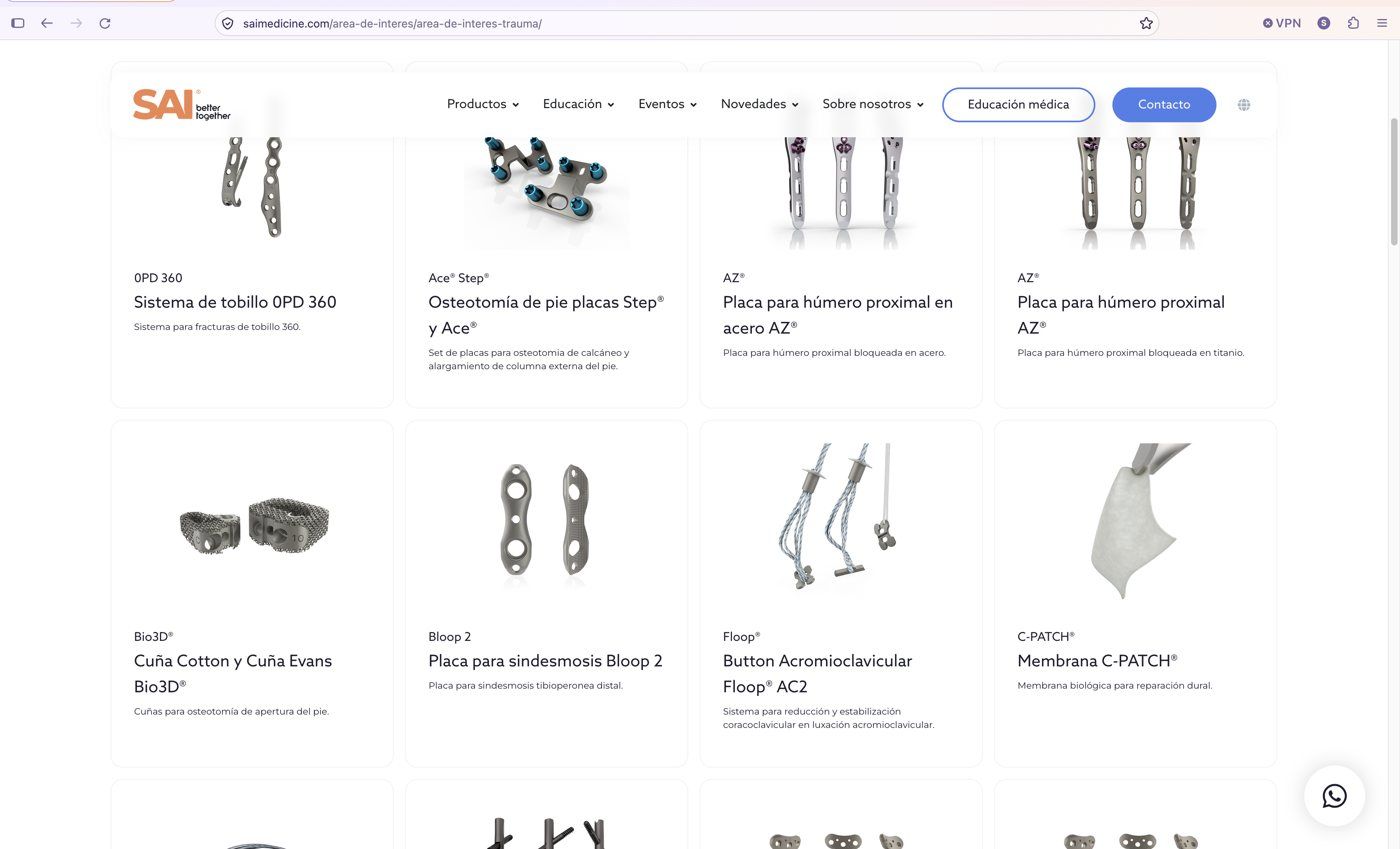
An orthopedic company manufactures its tibia plates in its own plant and also represents an international brand's arthroscopy instruments locally. In the knee section, both lines appear in the same grid. A surgical technologist opens the product page for a suture anchor and needs to know something that would be a minor detail in another industry: who manufactures it. That information appears on the label, in the IFU, and in the registration, and the product page has to say the same thing.
Who manufactures it and who offers it
In a mixed catalog, every product has at least two data points that can't be confused. One is the manufacturer: the company that produces the device and signs its documentation. The other is the company offering it, which, for a distributed line, owns the website but not the product. When the two are the same, nobody notices. When they aren't and the product page blurs them together, a foreign manufacturer's surgical technique guide ends up presented as the company's own material, or one of its own products gets buried among those of a better-known brand.
One catalog is enough to keep this in order, as long as the product page stores where each product comes from as a separate data point, apart from the trade name and the family. That way, a visitor can come in through an anatomical region or a procedure, see several brands together, and tell each one apart on opening it.
The brand belongs in a field
The most common way to show a distributed brand is to write it into the description: “Meniscal repair system by [brand].” That works until there are a hundred product pages like that. Finding out which products belong to that brand means reading them all, and the catalog filter doesn't recognize it because, to the system, it's free text.
When the brand is a field with a fixed list of values, the catalog can filter by it, and site search returns all its products when someone types the name. The brand also always appears in the same place on the product page, written the same way, regardless of who entered each product. The same goes for the manufacturer, if it's different from the brand, and for documents: a surgical technique guide from the distributed brand stays linked to its products and keeps its original identifiers.
At SAI, brand is one of the catalog's five navigation dimensions, along with anatomical region, area of interest, product type, and procedure. Nearly 270 products of different origins share the same listing.
When a distribution agreement changes
Distribution agreements change. A company stops representing a line, adds another, or starts manufacturing something it used to import. If the brand was typed by hand into every description, finding the affected product pages is a text search with unreliable results. If it's a field, the complete list comes out in a minute: which products, which documents, and which section pages display them.
With that list, each case is decided individually: what gets unpublished, what stays available for reference, and which URLs need a redirect. The redirects are there for a reason: a distributed catalog circulates for years in PDFs that sales reps sent by email, and the links in them keep sending people to the product pages long after the agreement has ended. What gets published and which version is valid is up to the company. The structure has to make it possible to carry that out without reviewing the site by hand.
Adding a new brand is the same work in reverse: the value is added to the list, the products are entered with their region and procedure relationships, and the filter already includes it. There's no need for a separate section for each supplier.
What searches show
There's one more reason for each product page to make clear where the product comes from, and it shows up in Search Console. Many people search for the international brand, not for the distributor.
At SAI, among the top 1,000 queries from sixteen months of Search Console data, 60 included the name of the international brand SAI distributes. Those queries added up to 31,721 impressions and 266 clicks: a 0.8% CTR. Google showed the distributor's site tens of thousands of times to people searching for that brand, and very few clicked through.
The figure doesn't explain the cause, but it shows where to look: which pages appear for those searches, whether the title names the brand and the product, and whether the product page people land on makes it clear that the device is available from that company.
Services covered in this article