Three months after the new site goes live, Management asks Marketing whether it worked. The report shows a traffic curve going up. Nobody can say how many of those visits were surgical technologists confirming a code, how many distributors downloaded a product line's catalog, or which products nobody opened during the entire quarter. The sales manager mentions that two surgeons brought up a product page. It's the only piece of information about the site anyone hears in the meeting.
In an online store, the purchase is the event that measures everything. At a medical device company, the sale happens far from the site and months later, between a sales rep, a purchasing department, and a tender. What the site can do is help the person find the product, get the document they need, and reach someone they can talk to. That's what gets measured.
Downloads, broken down by document type
Google Analytics' default setup records that someone downloaded a file and stores its name. It doesn't know whether it was a surgical technique guide, an IFU, a product line's catalog, or a congress brochure, or which product page it was downloaded from. For a manufacturer, those four downloads say different things: the technique guide is sought by someone about to operate or scrub in; the brochure, by someone just getting to know the product.
The measurement plan adds the document type, the product, and the language to each download. With that, it's possible to see which technique guides are viewed most, which lines have documentation nobody opens, and whether IFUs are downloaded from the product page or reached some other way.
What people search for and the catalog doesn't find
Site search is the most direct source of vocabulary a website in this industry has. That's where product codes, competitors' trade names, registration numbers, and the names surgeons use for something the catalog calls by another name all show up. Searches that return nothing are the most useful: each one is a product the person knew they wanted and couldn't find.
There's a technical detail that leaves this data out without anyone noticing. Analytics recognizes a search when the query stays in the page URL. Many catalogs with filters search without reloading the page, and in that case nothing is recorded. A custom event is needed for searches, and another for searches with no results.
At a company where every piece of copy goes through regulatory review before it's published, that list also helps prioritize the work: it shows which product pages to complete first and which synonyms to add, with data to justify each review request.
The products that don't appear in any report
Analytics lists the pages that received visits. A product page nobody opened during the period doesn't show up in the report with a zero: it simply isn't there. To see it, the full catalog list, which comes from the content management system, has to be cross-checked against the pages that received at least one visit.
Whatever is left after that cross-check is reviewed one by one. Some products are sold through tenders and nobody searches for them online. Others can't be reached through any filter, have a name nobody types, or were entered without their anatomical region. Those last ones get fixed in the catalog.
Each form, with the page it was sent from
The contact form of a company in this industry receives sales inquiries, complaints, résumés, and supplier offers, all through the same channel. Counting submissions without separating them says nothing. The plan distinguishes a request for advice from a product page, a course registration, a click on a sales rep's phone number or WhatsApp, and an inquiry about where to buy in each country, and it stores the page each one came from. That way, when an inquiry comes in, it's clear which product generated it.
What counts as a conversion is defined with the company before anything is set up. It usually includes a request for advice, a surgical technique guide download, and a course registration, and it doesn't include visits.
None of these records tracks the sale itself. What happens after the form depends on people and long buying cycles, and the site isn't evaluated on sales without data that connects one to the other. If the Sales team records where each inquiry came from, that connection exists and can be analyzed.
Signals that weren't in the plan
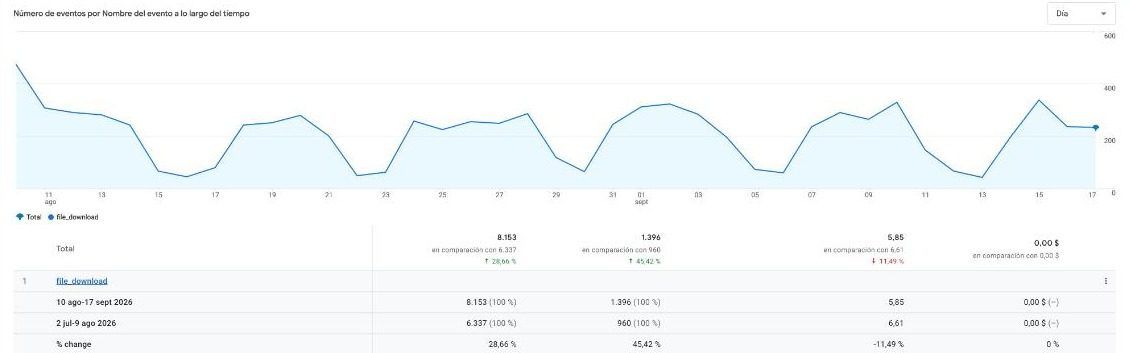
A measurement plan is put together before launch, and real-world use brings things nobody wrote down. At SAI, in the 39 days after the launch on August 10, 2026, Analytics recorded 7,303 video starts by 1,308 people. The number shows that video is part of how the site is used. To know which video and from which product page, the event has to carry that data, and that adjustment goes into the first review of the plan.
To compare before and after a launch, two windows of the same length are used, and traffic from search is separated from what the campaigns and announcement emails brought in. If they're mixed, the first month reflects the launch rather than the site.
Services covered in this article